About

Hi, I'm Kenny
- School: University of Washington
- Program: Biomedical and Health Informatics
Research Interests
Raised in a multicultural family, my research interests revolve around aligning clinical and digital environments with patient values, especially for
those often overlooked by our healthcare system. I focus on two main approaches: developing multimodal methods, including NLP techniques, to capture
patient preferences and contextual nuance from clinical narratives; and designing digital health interfaces through a human-computer interaction lens
to ensure innovations integrate seamlessly into real clinical workflows.
Outside of work, I am a big foodie on my journey to Yelp Elite status one cafe at a time. My current favorites in Seattle include Saint Bread and Cardoon.
I can also often be found running and bouldering in my free time.
Achievements
Volunteer Hours
Clinical Hours
Research Hours
GPA
Languages
Portfolio
- All
- Projects
- Posters
- Publications
Certifications & Education
Coursera
Google Data Analytics Specialization
Demonstrated hands-on experience with data cleaning, data visualization, project management, interpreting and communicating data analytic findings. Gained confidence in transforming complex data into actionable and clear insights.
Coursera
Mathematics for Machine Learning and Data Science
Studied core mathematics for machine learning and data science, including linear algebra, calculus, probability, and statistics.
Udemy
Python Data Analysis & Visualization Masterclass
Gained expertise with Python utilizing Pandas, Matplotlib, and Seaborn to analyze a wide array of datasets and create different kinds of visualizations.
CSE 527
Computational Biology
Introduces computational methods leveraging artificial intelligence (AI) and machine learning (ML) techniques to understand biological systems and enhance healthcare. Utilizes various AI/ML techniques, including explainable AI, interpretable ML, deep learning, probabilistic graphical models, and causal inference. Explores diverse problem areas such as genetics, epigenomics, transcriptomics, proteomics, imageomics, and electronic health records.
BIOST 517
Applied Biostatistics
Introduction to the analysis of biomedical data. Descriptive and inferential statistical analysis for discrete, continuous, and right-censored random variables. Analytic methods based on elementary parametric and non-parametric models for one sample; two sample (independent and paired), stratified sample, and simple regression problems.
BIME 530
Introduction to Biomedical and Health Informatics
Overview of biomedical and health informatics concepts, theories, and applications, including the historical evolution and the current and future research directions within the context of information flow in healthcare settings.
BIME 533
Public Health and Informatics
Introduction to the emerging field of public health informatics. Covers general public health topics as well as key public health informatics issues and applications. Evaluates a public health information system.
BIME 534
Biology and Informatics
Provides an introduction to some of the fundamental concepts in core fields of biology; the information representation and management problems that arise from these fields; and current and potential informatics solutions to these problems.
BIME 535
Clinical Care and Informatics
Explores the ways in which information technology affect healthcare delivery system design and delivery. Considers current and future research questions and trends as well as current and future application opportunities and challenges.
BIME 537
Informatics Research and Evaluation Methods
Introduces the many facets of evaluation and research for biomedical and health informatics projects. Focuses on formal studies of the application of information technology in medicine, conducted while an information resource is under development and after the resource is in routine service.
BIME 543
Consumer Health Informatics
Provides an introduction to consumer health informatics (CHI) including theories of health behavior and information behavior; key concepts and terminology; and application domains. The course will cover issues such as health literacy, patient-centered communication, patient empowerment, and privacy; and application domains including personal health records, m-Health, and telehealth.
BIME 550
Knowledge Representation and Applications
Defines knowledge representations and explores how knowledge presentations and ontologies are used in the semantic web and why these issues are important for biomedical informatics application builders. Uses a research focus to explore foundational theoretical issues and choices facing application builders.
BIME 554
Biomedical Information Interactions and Design
Introduction to theoretical frameworks and research methodologies that underpin the study of human-information interactions and the design of biomedical information systems to support them. Emphasis on understanding informational needs and specifications that drive the design of health information systems.
BIME 591
Introduction to Selected Topics in Medical Imaging and Informatics
Introduces topics relevant to medical imaging modalities and their informatics applications. This includes but is not limited to fundamentals in several clinical imaging modalities (MRI, CT, PET), machine learning applications, and integration with clinical health informatics.
BIME 435
Informatics in Healthcare
Introduces information technology applied in healthcare across three modules that (1) overview the U.S. healthcare system, (2) establish an understanding of clinical information systems used in healthcare, including electronic health records, and (3) survey applications in clinical informatics, such as virtual health care and the learning health system.
GENOME 373
Genomic Informatics
Focuses on methods for analyzing large genetic data sets and their application to biological problems, including sequence alignment and search methods, gene prediction, phylogenetic trees, and microarray analysis.
BIOL 464
Molecular Mechanisms of Cancer Seminar
Molecular mechanisms of cancer and therapeutic strategies designed to treat cancer. Additional focus on intersection of medicine and society, including racial health disparities, patient ethics, and informed consent.
BIOL 350
Foundations in Physiology
Analysis of basic principles of animal and plant physiology, with emphasis on cellular processes that mediate organismic processes.
BIOL 355
Foundations in Molecular Cell Biology
Emphasis on molecular approaches to understand cell structure, function, and regulation, and the analysis of experimental design and data interpretation.
BIOL 466
Pathobiology of Emerging Diseases
Examination of the causes, alterations in cellular function, and remediation of emerging diseases in plants and animals from a global perspective.
GENOME 361
Fundamentals of Genetics and Genomics
Introduces fundamentals concepts in genetics and genomics including patterns of inheritance, genetic variation, and the relationship between genotype and phenotype.
Resume
Professional Experience
Medical Data Specialist
April 2022 - April 2024
All4Cure
- Extracted oncology biomarkers and patient histories from electronic health records
- Developed interactive dashboards for 100+ myeloma patients, improving oncologist access to longitudinal biomarker data and chemotherapy response patterns
Oncology Intern
January 2022 - June 2022
Lifespring Cancer Treatment Center
- Collected vitals, assisted in clinical examinations, and documented medical history in electronic health record
Student Assistant
August 2021 - January 2022
UW Medical Center - Montlake
- Admitted and screened patients for all departments at the front desk of the hospital and guidedpatients to appointments as needed
IT Student Assistant
March 2019 - September 2021
Learning Spaces UW Foster School of Business
- Provided AV support both in person and through an email-based ticketing system to over 50 classrooms, conference rooms, team rooms, and computer labs
- Designed manuals to efficiently teach new student assistants how to best troubleshoot common AV issues
Research Experience
Graduate Research Assistant
November 2024 - Present
UW Biomedical and Health Informatics
- Developing and evaluating predictive models to characterize the severity of auditory verbal hallucinations
- Co‐designing caring contacts protocols and remote monitoring systems for suicide risk among adolescents and young adults in primary care settings
Undergraduate Research Lead
November 2020 - June 2022
Ola Pasifika Lab
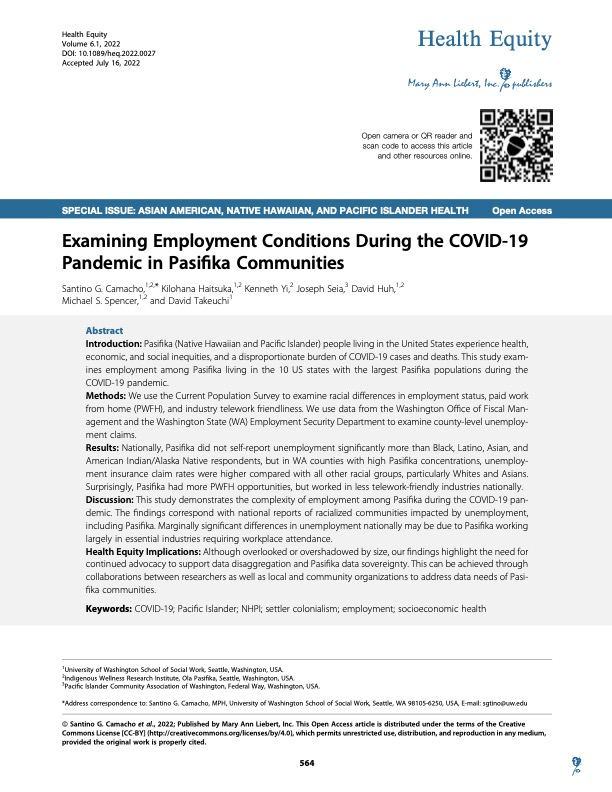
- Conducted cross‐tabulation analysis and logistic regression of Current Population Survey data and Washington State Employment data using R to examine racial differences in employment among Pasifika communities during the COVID‐19 pandemic
- Prepared and presented lectures on R and quantitative data analysis principles to fellow research assistants